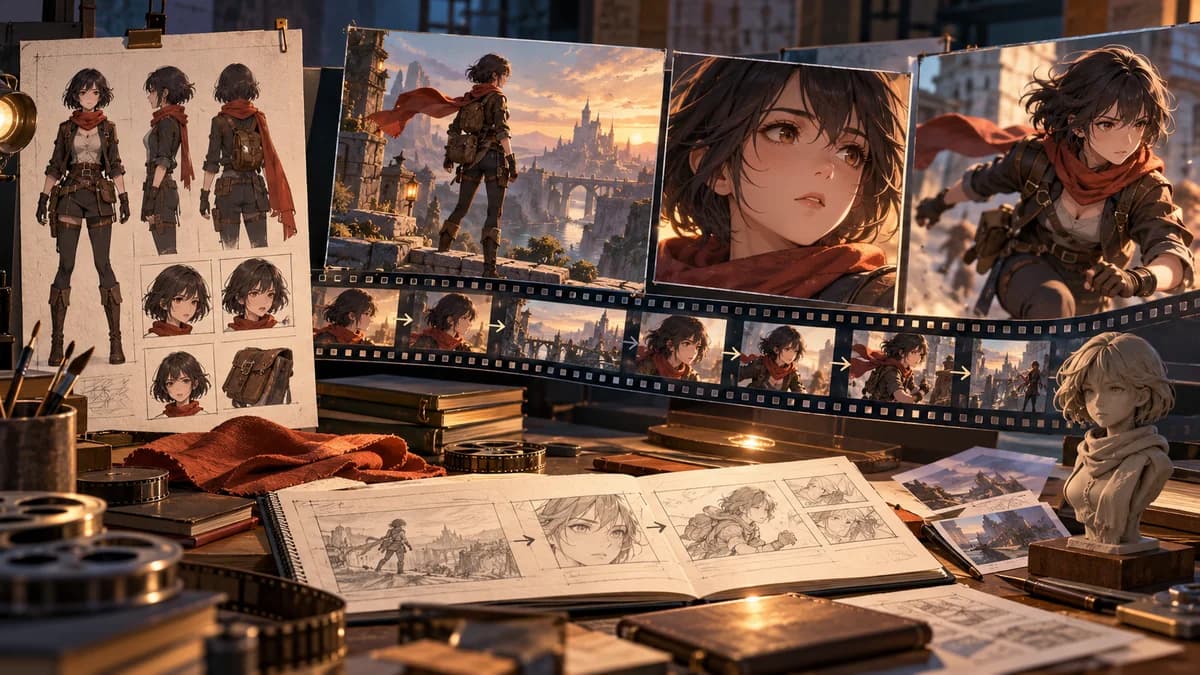
Duanju is the romanized Chinese word for 短剧, or short drama. In mobile entertainment, it commonly refers to short, serialized fiction built around recurring characters and an ongoing story. English coverage also uses microdrama, short drama, and vertical drama. Many episodes run for roughly one to three minutes, although lengths and delivery requirements vary by platform. Duanju News explains the terminology.
For a creator, the useful question is how to turn that format into a repeatable production process. An AI short drama still needs a script, a coherent sequence of shots, recognizable characters, dialogue, and an edit that gives viewers a reason to continue.
This guide uses an original 60-second planning example. It is a teaching exercise, not a generated film, customer case study, or promise of production speed.
Duanju, microdrama, vertical drama, and AI manju
These terms describe different aspects of a project and should not be treated as interchangeable tool features.
| Term | What it tells a creator | What it does not guarantee |
|---|---|---|
| Duanju / short drama | A short dramatic format; in this context, serialized storytelling | AI generation, a particular visual style, or one fixed episode length |
| Microdrama / micro-drama | A common English label for very short episodic fiction | A universal distribution or payment model |
| Vertical drama / vertical series | A mobile portrait presentation, often planned for 9:16 | That cropping a widescreen film will preserve its framing |
| AI short drama | AI assists one or more production stages | A complete series from one prompt or automatic continuity |
| AI manju / animated short drama | An animated or illustrated approach to episodic storytelling; usage varies | That every short drama is a motion comic |
A duanju can be filmed with actors, animated, or made with a combination of methods. A motion comic is one possible visual treatment. For that specific workflow, use the AI motion comic production guide.
How to make an AI short drama: start with an episode brief
Write four decisions before choosing a video model:
- Character goal: what does the protagonist want in this episode?
- Obstacle: what prevents an immediate resolution?
- New information: what changes the audience's understanding?
- Unfinished question: what makes the next episode necessary?
For our example, a shopkeeper wants to close for the night. A courier arrives with a letter she refuses to accept. The handwriting belongs to her mother, but the postmark is dated tomorrow. The final beat raises a specific question: who sent it?
Keep the first test small: two characters, one location, and a single reveal. Set the intended aspect ratio and spoken language before generating assets. A 60-second edit is a planning target, not a required model output duration.
A 60-second vertical drama storyboard
The following is an editorial shot plan. Longer beats can require several generated clips; available clip durations depend on the selected model and mode. Time the actual spoken performance before locking the edit.
| Shot | Edit time | Framing and action | Continuity check |
|---|---|---|---|
| 01 | 6 seconds | Portrait wide shot: the shopkeeper pulls down the blind; a knock interrupts her | Establish the door and counter positions |
| 02 | 8 seconds | Medium shot: the courier offers an envelope across the counter | Keep the envelope in the same hand |
| 03 | 10 seconds | Reverse shot: she refuses it and turns away | Match eyelines and screen direction |
| 04 | 12 seconds | Insert and reaction: she recognizes the handwriting | Add readable letter text in the edit |
| 05 | 14 seconds | Close-up: she checks the postmark, then looks at the courier | Preserve costume, prop orientation, and lighting |
| 06 | 10 seconds | Return to the envelope: tomorrow's date; cut before the courier answers | Leave space for the reveal and subtitles |
The six beats total 60 seconds. They are not six prompts to generate blindly. Review a still-image sequence first: can someone understand the exchange without an explanatory paragraph? For a fuller breakdown and editable shot-list templates, continue to the script-to-storyboard workflow.
Keep characters consistent across episodes
Create a small reference set before animating: the shopkeeper and courier, their costumes, the counter, the doorway, and the envelope. Assign stable names and keep the approved reference version with each shot. Separate identity details from changing emotions or actions.
Generate and review storyboard frames before sending them to image-to-video. Compare faces, clothing, prop placement, lighting, and eyelines across adjacent shots. If shot 03 fails, revise that shot with its original references instead of rewriting the whole episode. References reduce drift; they do not guarantee identical outputs.
For portrait delivery, check the actual target app's overlays and subtitle placement. Keep faces and the letter reveal readable inside the usable area. Do not assume there is one safe-area measurement for every platform.
Prompts should describe one shot
Use a shot prompt with approved references rather than pasting an entire episode into a short clip request. For shot 02, a starting point is:
Portrait medium shot inside the established shop. The courier extends the same cream envelope across the counter with his right hand. The shopkeeper watches without taking it. Restrained movement, stable camera, warm evening lighting. Preserve both characters' approved costumes and the established counter layout.
This is an untested teaching prompt, not a universal provider syntax. Select the references and supported duration in the chosen tool. Add dialogue through the available audio workflow and check its timing in the edit; do not assume every model produces synchronized speech.
How much does an AI short drama cost?
Budget for accepted footage, not only the first generation. A useful estimate is:
Video generation cost = generated seconds × price per second, with separate lines for images, reference-input charges, voice, editing, and any other provider fees.
As a hypothetical example, a 60-second episode with three full-duration candidate passes means 180 generated seconds. At an assumed $0.10 per second, video generation alone would cost $18. Neither that rate nor the three-pass assumption is an AniKuku quote or a measured acceptance rate. Check the selected model's current billing rules, including whether reference video is charged.
For more detailed assumptions and input charges, see the video API cost guide. Compare a short pilot's actual accepted seconds, retries, and editing time before budgeting a series.
Using AniKuku for the production workflow
AniKuku connects script breakdown, reusable characters and scenes, storyboards, voice, and shot-level video work in a project. Use the production features to organize an episode and review its shots. Available generation modes depend on the configured provider; a guide describing a format does not mean every provider feature is available in the workspace.
Start with the storyboard sequence above, then test a few difficult shots before expanding the episode. Review the final cut for dialogue timing, subtitle legibility, continuity, music and asset permissions, and the destination platform's current publishing requirements. AniKuku is a creation workspace, not a catalog of dramas to watch or a guarantee of distribution acceptance.
FAQ
Does duanju mean AI-generated drama?
No. It describes a short drama format. AI is a production method that can assist with scripts, references, storyboards, voice, or clips.
Is a microdrama the same as a vertical drama?
The labels often overlap. Microdrama emphasizes short episodic storytelling; vertical drama emphasizes portrait presentation. Confirm the actual project specification rather than relying on a label alone.
Can AI make a complete short drama from a script?
AI can assist multiple stages, but a usable episode still needs continuity checks, timing decisions, and editing. Breaking a script into reviewed shots gives you a practical way to repair individual problems.
Where should a first-time creator begin?
Write one episode with a clear reveal, approve two character references, and build a small storyboard sequence. Test that sequence before committing to a full season. Explore the workflow or see motion comic examples.