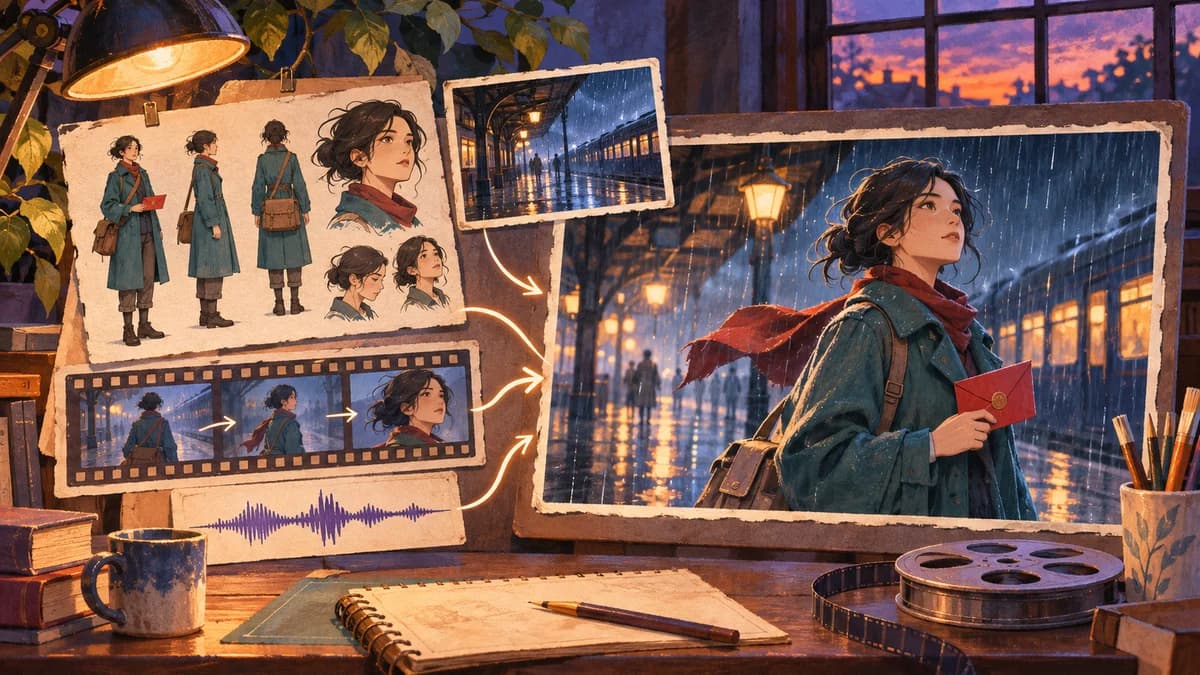
MAGI-2 is Sand.ai's new flagship audio-video model. Its November 24, 2026 research announcement describes 480B total parameters, about 28B active, and output up to 30 seconds at 1080p and 25 fps. For filmmakers, the practical changes are longer takes, mixed image/video/audio references, timed cuts and synchronized sound.
This guide checks the official release, Sand API and Higgsfield documentation on November 25. AniKuku has not run paid MAGI-2 generations. The example below is a proposed production test.
Which MAGI-2 can you use or download?
| Version | Parameters | Delivery and availability |
|---|---|---|
| MAGI-2 flagship, November 2026 | 480B total, about 28B active, per Sand.ai | Hosted model; full weights and a detailed technical report are planned |
| MAGI-2 Preview, August 2026 | About 114B total, 6B active | Downloadable research model, ten-second T2V/I2V clips with audio |
The Preview model card describes the separate research release. For downloadable components, their license boundaries and the official local execution path, see the MAGI-2 open-source and self-hosting status guide. Flagship weights and a supported local configuration remain unconfirmed.
Higgsfield's launch announcement uses “400B” while Sand.ai's research post specifies 480B. We use the developer's 480B figure and retain that discrepancy. The same technical post explains that a dedicated upscaler reuses original reference images for 1080p delivery, so the output label alone does not establish the base generation resolution.
Where is the API available?
Sand's model and pricing page lists magi-2 at USD 0.08 per generated second at 1080p. It also says account top-up is temporarily unavailable. Confirm organization access, balance and current account conditions before scheduling work.
Higgsfield publishes a text-to-video API and three-mode catalogue, with text, image and reference generation at $0.08/s. Its documented limit is one concurrent generation per account across MAGI-2 modes. Higgsfield app credits have their own purchase terms. Credentials and billing belong to the selected provider.
The launch partner's exclusivity wording coexists with Sand's own published API documentation. Use each channel's current access conditions. AniKuku currently has no MAGI-2 generation integration.
Choose references or first/last frames
Sand's native API uses POST https://api.sand.ai/v2/generations, Authorization: Bearer, and model: "magi-2". Its parts array accepts one text item plus up to 20 references.
| Reference type | Limit per request | What to specify in the prompt |
|---|---|---|
| Image | Up to 10 | Character, wardrobe, prop or location |
| Video | Up to 5, 2–30 seconds each, at most 30 seconds combined | Motion, staging or camera path |
| Audio | Up to 5, at most 30 seconds combined | Intended voice, rhythm or sound role |
Native references use reference_image, reference_video or reference_audio, with an uploaded asset ID or a public HTTPS URL. Preserve input order and explain each reference's purpose.
For a fixed opening or ending composition, Sand's Ark-compatible interface exposes first_frame and last_frame roles. It accepts a first frame alone or both frames together. Frame requests exclude general image, video and audio references. Supported settings are 4–30 whole seconds, 1080p, and six ratios from 21:9 to 9:16. Native aspectRatio and Ark ratio are different field names.
After native creation returns HTTP 202, save the generation ID. Retrieve that task until it succeeds or reaches a failure/cancellation state, then download output.videoUrl. A lost create response needs investigation because resubmission can create another billable task.
Budget for the shots you keep
At the published $0.08/s API rate, simple output-only calculations are $0.40 for five seconds, $0.80 for ten, and $2.40 for thirty. A twelve-second attempt is $0.96. Four billed twelve-second attempts would be $3.84 before any other charges and production work. This is an assumed budget, not a measured acceptance rate. Check the provider's current quote and failed-task billing.
For a motion-comic test, prepare a courier design, a rainy platform reference and a short camera guide. Request a twelve-second sequence with three beats.
| Time | Proposed action and edit |
|---|---|
| 0–4 s | Wide shot. The courier stands beside a pillar, holding a sealed red envelope. Rain and approaching footsteps. |
| 4–8 s | Cut to a medium shot. She turns toward the footsteps while keeping the envelope in the same hand. |
| 8–12 s | Cut to a close-up. She raises the envelope, then holds for the edit. Keep the coat and station lighting consistent. |
Label the design as appearance, the platform as location and the guide as camera motion. Review the hand holding the envelope, costume, cut timing and sound before adding more material. Keep a separate pass/fail record for visuals and audio. Start with the editable storyboard shot list if the scene still needs planning.
Sand.ai identifies fast-motion trajectories, overly smooth local motion in some 2D shots and layered soundscapes as remaining weaknesses. Test those in your actual style. Higgsfield's Arena placed MAGI-2 second in its November 24 snapshot, but that provider-run vote is separate from your shot's acceptance criteria. For other production options, see the AI video model overview.