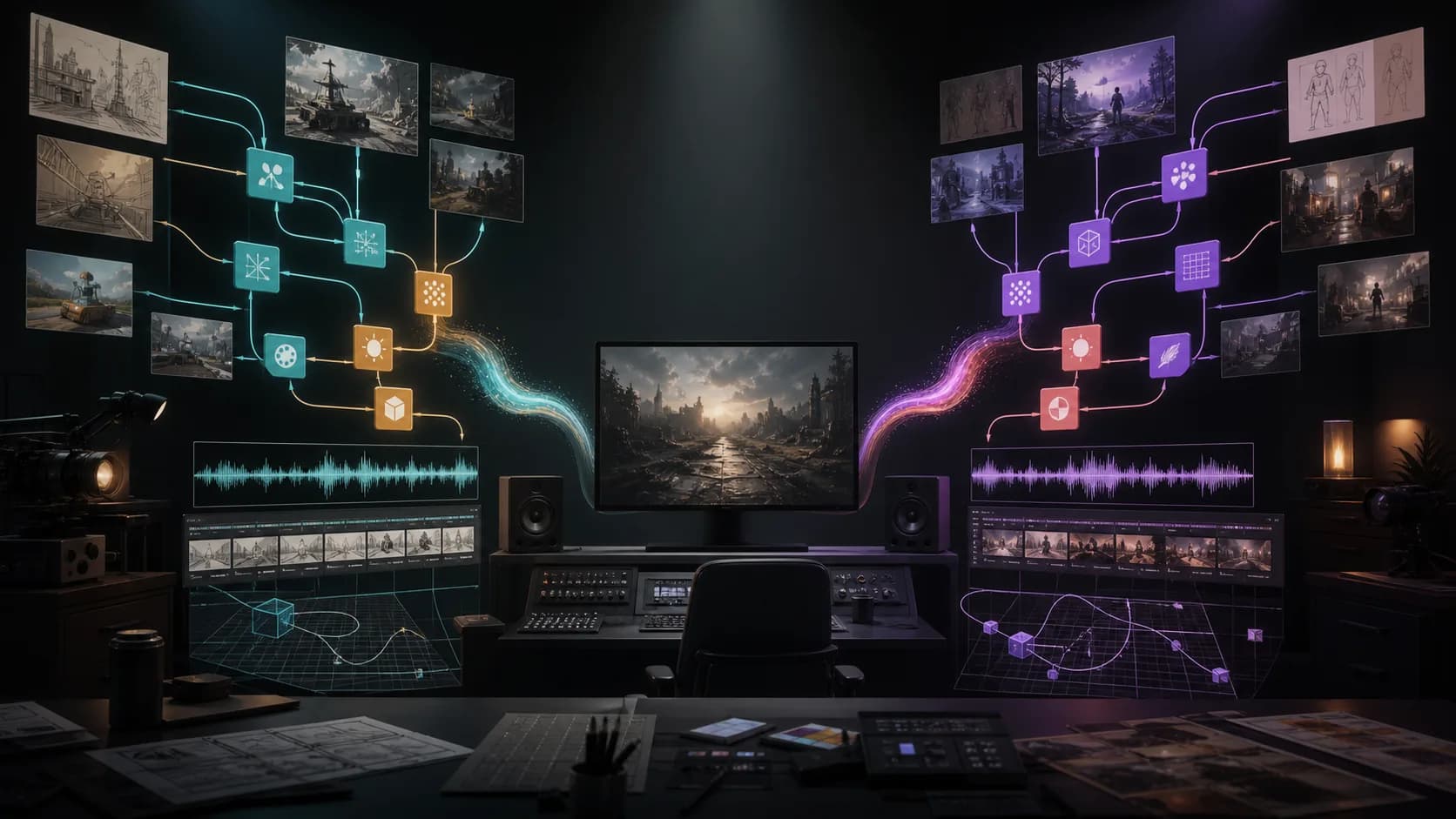
Wan 3.0 vs Seedance 2.5, checked August 8, 2026: neither model is the automatic winner. Wan 3.0 has documented 1080P API output and simple per-second pricing. Seedance 2.5 accepts more reference assets and documents video editing and extension. Both can generate up to 30 seconds with audio, but no controlled evidence proves that either one is universally better for character consistency, motion, latency, or finished-production cost.
There is an access caveat on both sides. Alibaba Cloud publishes the wan3.0-video API and prices, but still labels the model preview or invitation-only. Dreamina says Seedance 2.5 is live globally, and BytePlus lists dreamina-seedance-2-5-260628 in its international ModelArk documentation, but activation, quota, and region still need to be checked in the account that will run it.
This article compares documented product facts and production fit. AniKuku has not run a same-input benchmark of the two current models, so it does not turn selected launch clips into a quality ranking.
Wan 3.0 vs Seedance 2.5 at a Glance
| Area | Wan 3.0 | Seedance 2.5 |
|---|---|---|
| Official model ID | wan3.0-video | dreamina-seedance-2-5-260628 |
| Access status | Alibaba Cloud API is documented as preview; pricing page says invitation-only | Dreamina says live globally; international BytePlus ModelArk documentation is available |
| API regions | Beijing and Singapore endpoints are documented | International BytePlus ModelArk; verify account activation and region |
| API resolution | 480P, 720P, 1080P | 480p, 720p; API documentation says 1080p and 4K are not supported |
| Output duration | 2–30 seconds | 4–30 seconds |
| Reference limits | Up to 10 images, 5 videos, 5 audio files | Up to 30 images, 10 videos, 10 audio files, 50 items total |
| Main workflows | Text, first-frame, first/last-frame, reference-to-video, file and public-page context | Text, first-frame, first/last-frame, reference-to-video, editing, extension |
| Audio | Generated by default; can be controlled in the request | Generated audio with a request control; audio references supported |
| Pricing unit | Per output second and resolution | Per token, with a different rate when video input is present |
| Open weights | No official Wan 3.0 checkpoint or license verified | No official Seedance 2.5 checkpoint or self-hosting license verified |
The headline distinction is practical. Wan is easier to quote before a job because the rate is tied to seconds and resolution. Seedance offers a larger reference budget and broader edit-and-extend workflow, but its token bill cannot be translated into a reliable clip price without the actual request and usage record.
Access: A Preview API and a Live Creator Product
“Released” can mean three different things: a public product page exists, an API schema exists, or a particular account can submit a job. A production team needs all three to line up.
Alibaba Cloud's release log lists Wan 3.0 as a public-beta model. Its API reference then marks wan3.0-video as preview, while the Chinese pricing table uses the invitation-testing label. The documentation is specific enough to plan an integration, including Beijing and Singapore endpoints, but not specific enough to promise that every Model Studio account has immediate access.
Seedance 2.5 has moved beyond its earlier “coming soon” state. Dreamina now says the product is live globally, and BytePlus has published an international API tutorial, model ID, and pricing resources. That still does not make access identical across every customer. Before development, confirm activation, token resources, concurrency, moderation rules, output retention, and the region where uploaded references will live.
For either model, take a screenshot or export of the model selector and live quote when the test begins. Availability pages can change faster than a production plan.
Inputs and Creative Control
Wan 3.0 accepts up to 10 images, 5 videos, and 5 audio files. It covers the common narrative starting points: text-only generation, a first image, paired first and last frames, or a set of references. Its documentation also describes file and public-page context, which can be useful when a brief, storyboard, or source page needs to inform the request.
One limit matters when using video references: input-video duration plus requested output duration cannot exceed 30 seconds. Five references do not mean five long clips plus a 30-second result. A team must decide whether each video teaches motion, performance, camera behavior, or continuity, then spend the available duration budget deliberately.
Seedance 2.5 allows a larger package: up to 30 images, 10 videos, and 10 audio files, with 50 references in total. It also documents video editing and extension, not just generation from a blank prompt. That makes it attractive when an approved clip needs a local change or a longer continuation, or when a motion-comic shot draws on a character sheet, costume views, location art, performance reference, and dialogue at the same time.
More inputs do not guarantee better control. Conflicting face angles, lighting, motion, and audio can make the brief less clear. A good request labels the role of each reference and removes anything that does not change the intended result.
Resolution, Duration, and Audio
Wan 3.0 currently has the higher documented API resolution: 1080P, compared with Seedance 2.5's 720p API ceiling. Both also offer lower-resolution modes that are useful for inexpensive iteration. For a fair visual comparison, test both at 720p first. A 1080P Wan render against a 720p Seedance render would mix model behavior with output-size differences.
Seedance needs one extra clarification. Dreamina's consumer page promotes 4K and an experimental 180-second workflow. The current BytePlus API tutorial explicitly supports 480p and 720p and says it does not support 1080p or 4K. It also caps one API output at 30 seconds. Web-product marketing and ModelArk request limits are both real, but they describe different surfaces.
Wan produces 2-to-30-second clips. Seedance produces 4-to-30-second clips. Wan generates audio by default, and Seedance exposes a generated-audio option and accepts audio references. These facts establish audio capability, not lip-sync accuracy, voice quality, or multilingual performance. Those remain test questions.
Pricing: Why the Numbers Do Not Convert Cleanly
Wan 3.0 uses a rate that is easy to calculate:
| Region | 480P | 720P | 1080P |
|---|---|---|---|
| Beijing | ¥0.30/sec | ¥0.60/sec | ¥1.20/sec |
| Singapore | ¥0.37471/sec | ¥0.74942/sec | ¥1.49884/sec |
A ten-second 720P request is therefore listed at ¥6 in Beijing or ¥7.4942 in Singapore before retries. Turning audio generation off does not change Wan's documented per-second price.
Seedance 2.5 is token-based. BytePlus lists $0.0064 per 1,000 tokens for requests with video input and $0.0107 per 1,000 tokens for requests without video input. Resource packages are $32 for 5 million tokens, $64 for 10 million, and $640 for 100 million. The packages expire after 90 days and are non-refundable. The activation tutorial says a resource package must be purchased and activated first; usage beyond the package can draw from the account balance on a pay-as-you-go basis.
It would be misleading to turn that into a single Seedance “price per second” without a usage trace. Input type, references, output, failed jobs, and retries all affect the final bill. The fair production metric is:
total generation, retry, review, repair, and storage cost ÷ approved final seconds
That number may favor a model with a higher request price if it reaches an approved shot in fewer attempts.
Which Model Fits Which Workflow?
Wan 3.0 is the more direct first test when the project needs a documented 1080P API result, a predictable seconds-based budget, first-and-last-frame control, or file and public-page context. Its main operational risk is access: preview and invitation labels need to be cleared in the intended Alibaba Cloud account.
Seedance 2.5 is the more direct first test when the shot needs many references, a documented local edit, an extension of an existing clip, or a Dreamina creator workflow alongside an API. Its main budgeting risk is variable token use, and its current ModelArk resolution limit is 720p.
For a motion comic, neither specification answers the hardest questions. Can a face survive speech and a head turn? Does the same costume return after an establishing shot? Can a hand pick up a prop without changing it? How often does a completed clip survive the edit? Those are measured outcomes, not release-page features.
How to Run a Fair Wan 3.0 vs Seedance 2.5 Test
Use two test groups. The first holds conditions as equal as possible. The second tests each model's native advantage.
For the equal-condition group:
- Use the same creative intent, aspect ratio, 720p output, duration, dialogue, and acceptance rules.
- Use reference sets that fit both models' lower shared limit rather than filling Seedance's larger allowance.
- Generate each shot several times and keep every attempt, not only the selected clip.
- Do not force the same seed. A seed value is not comparable across different model families.
- Record queue time, generation time, failures, billed usage, human review, and the first take that passes.
For the native-capability group, test Wan's first/last-frame and file-context workflows, then test Seedance's larger reference set, editing, and extension. This answers a different but useful question: which model's distinctive controls solve work the other test cannot represent?
A 12-to-20-shot suite should include a quiet close-up, dialogue, full-body movement, hand-to-object contact, two-character staging, a fast action, a camera move, vertical composition, a scene extension, and a later shot that must match an earlier approved scene.
What the Current Demo Videos Can Prove
The first video is a timely independent Wan 3.0 review. Its title asks whether the model is a “Seedance killer,” which makes it relevant to the current search, but the title is a question, not a test result. The video does not establish a controlled same-input benchmark against the current Seedance 2.5 API.
The second comparison includes Wan 3.0, but its Seedance side is version 2.0, alongside other models. It is useful for spotting test ideas such as camera motion, prompt adherence, and continuity. It cannot settle Wan 3.0 vs Seedance 2.5.
For any demo, look for the provider, exact model ID, complete prompt and references, settings, failed attempts, queue time, and billed usage. Without those details, a good clip shows possibility, not repeatability.
AniKuku Production Recommendation
AniKuku does not currently claim a production integration with Wan 3.0 or Seedance 2.5. A responsible adoption test would use real motion-comic shots and keep scripts, characters, scenes, storyboards, references, and approval history outside the model. That lets a failed shot move to another provider without rebuilding the episode.
The recommendation is to run the equal-condition 720p test first, then one native-capability test for each model. Choose on approved output rate, review time, operational reliability, and cost per approved second. A winner from one polished prompt is not enough to change a production pipeline.
FAQ
Is Wan 3.0 better than Seedance 2.5?
There is no controlled evidence for a universal winner. Wan 3.0 has documented 1080P API output and simpler per-second pricing. Seedance 2.5 offers more references plus editing and extension. Test the exact workflow, account, and shots you plan to publish.
Do Wan 3.0 and Seedance 2.5 both have APIs?
Yes. Alibaba Cloud documents wan3.0-video for Beijing and Singapore, although it remains preview or invitation-only. BytePlus documents dreamina-seedance-2-5-260628 internationally, subject to account activation, quota, and region.
Which model supports 1080p or 4K?
Wan 3.0's API documents 1080P. Seedance 2.5's current BytePlus API documents 480p and 720p, not 1080p or 4K. Dreamina's separate creator product advertises 4K, which should not be presented as the API specification.
Which one is cheaper?
The billing systems are not directly comparable. Wan charges per output second and resolution; Seedance charges per token and input type. Compare the complete cost of all attempts that produce an approved final second.
Which is better for character consistency?
No current controlled benchmark answers that question. Seedance's larger reference allowance may help a reference-heavy workflow, but more inputs do not guarantee fidelity. Test identity across several connected shots, not one portrait animation.
Which is better for motion comics?
Wan is a strong candidate for 1080P, first/last-frame planning, and predictable quotes. Seedance is a strong candidate for reference- heavy, edit, and extend workflows. Production reliability should be decided with a multi-shot sequence and approval-rate data.
Sources
- Alibaba Cloud Wan 3.0 API reference
- Alibaba Cloud Model Studio pricing
- Alibaba Cloud newly released models
- BytePlus Seedance 2.5 API tutorial
- BytePlus Seedance 2.5 pricing and resource packages
- BytePlus model catalog
- Dreamina Seedance 2.5 product page